


Orange Riviera won the Diana with authority and confirms Belmont’s dominance among the females of the 2022 generation
- Lineage Bloodstock
- 1 day ago
- 7 min read

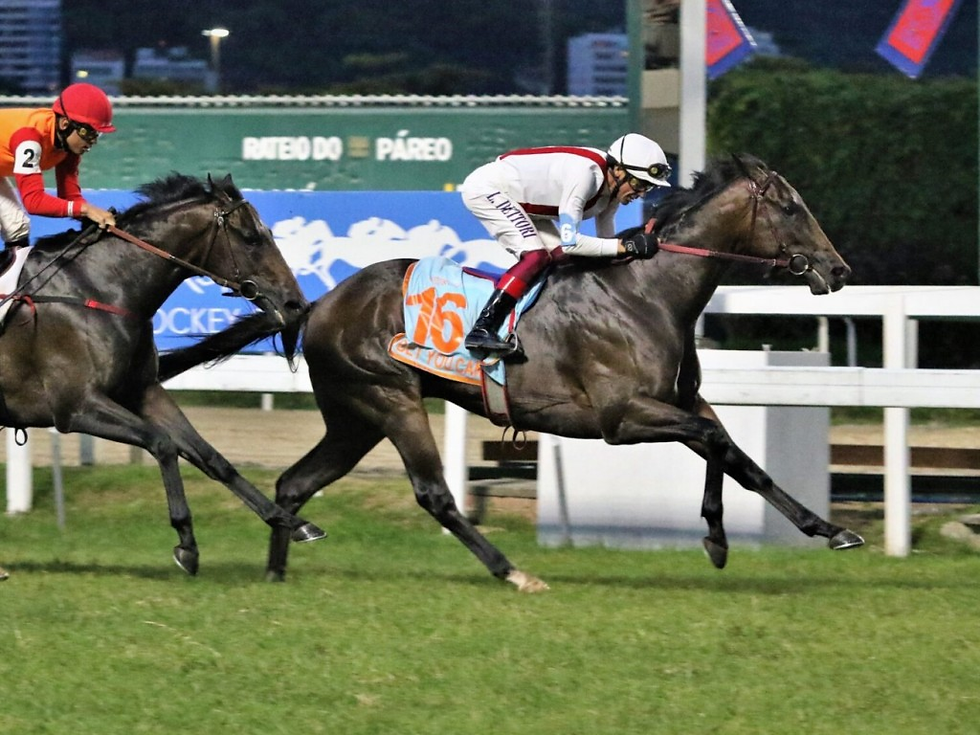
The victory of Orange Riviera (Put It Back) in the Grande Premio Diana (G1), run on the afternoon of March 8 at Hipódromo da Gávea, Rio de Janeiro, represents one of the most significant episodes of the Brazilian classic calendar this season. The race, the second leg of the Rio filly Triple Crown, was run over 2,000 meters on turf and brought together several of the best representatives of the 2022 generation. In that context, Orange Riviera produced a spectacular late run to secure her first Group 1 victory and confirm the extraordinary sporting moment of the association between Haras Belmont, owned by Dante Franceschi, and the breaking and training system led by veterinarian Dr. Aline Vivan at Haras Santa Julieta.

The development of the race was intense from the start. After the withdrawal of Olympic Puma in the alignment works, thirteen fillies were finally left in competition. From the break, Wendy Rose assumed the lead and set a demanding pace, opening several lengths over her pursuers while the field began to sort itself out. Meanwhile, young jockey João Victor opted for a strategy of complete patience with Orange Riviera. He kept her in the back positions, even around tenth place for much of the race, without allowing himself to be dragged along by the strong tempo imposed up front. This decision was key, because it allowed the filly to reach the stretch with reserves of energy when several of her rivals were beginning to feel the strain.
On the big Flamengo turn, the picture began to change. Odalisca moved closer to the leader and took command, while Riva Mc placed herself in a stalking position. Veil, winner of the first leg of the Triple Crown and the public’s heavy favorite, was advancing on the outside trying to keep her title hopes alive. At that moment, Orange Riviera was still at the back of the field, but João Victor was beginning to look for openings between rivals. In the final 300 meters, the race opened up completely. Odalisca seemed to have the situation under control, but from the inside an unexpected figure emerged: Orange Riviera found a lane between the runners and launched a decisive acceleration.
In the final 150 meters, the daughter of Put It Back produced a powerful late charge that left her rivals without an answer. She took the lead with great determination and held her advantage against the late attack of Oh Promise Me, who advanced to complete the exacta by approximately one length. Veil, who broke from the uncomfortable gate 14, completed third after a sustained effort throughout the stretch. Behind them finished Odalisca and Riva Mc, completing the board of a race that proved tactical and demanding. The final time of 1:58.99 for the 2,000 meters confirmed the quality of the race and the merit of the winner, who knew how to take advantage of a development ideal for her running style.
With this performance, Orange Riviera reached her fourth victory in nine starts, consolidating a progressive campaign that already included wins in the Clásico Emerald Hill (Listed) at Cidade Jardim and the Clásico Criadores (Listed) at Tarumã. She had also been placed in group races before this victory, such as her third in the Grande Premio Henrique de Toledo Lara (G2) and her second in the Grande Premio Roger Guedon (G3) at Gávea. The win in the Diana not only represents the high point of her campaign so far, but also a confirmation that the filly had been regularly and competitively facing the best of her generation.

The ride by João Victor was one of the aspects most praised by the Brazilian specialized media. With only a few Group 1 victories in his career, the young rider showed notable maturity by not compromising his mount prematurely. The patience with which he waited for the right moment and the skill with which he found the decisive opening between rivals in the stretch reflected a ride of high class. In Brazil he is already considered one of the emerging jockeys with the greatest projection, and his victory aboard Orange Riviera reinforces that perception within the competitive world of Rio racing.
Special recognition is also due to trainer Mauricio S. Oliveira, a professional based in Paraná who has built a solid reputation for the consistency of his results when shipping his horses to the country’s major racetracks. Oliveira not only prepared Orange Riviera for this victory, but also trains other important figures of the Belmont stable. His ability to keep his runners in optimal physical condition, even while traveling long distances between racing centers such as Cidade Jardim in São Paulo and Gávea in Rio de Janeiro, has become one of the keys to the team’s success.
From a sporting standpoint, Orange Riviera’s victory also had an immediate consequence in the filly Triple Crown. Veil’s defeat in this second leg eliminated the possibility that Brazil would have a new filly Triple Crown winner from the 2022 generation. However, the fact that both protagonists belong to the same owner, Haras Belmont, maintains that stable’s dominance over the generation. In fact, Dante Franceschi’s stable had already achieved important victories in other classic races of the season, consolidating an extraordinary period for his program of selecting and acquiring fillies.
Orange Riviera’s story also reflects an interesting business model within the South American racing industry. Born at the prestigious Haras Santa María de Araras, one of the most influential breeding farms on the continent, the filly was later acquired by Dante Franceschi and raised at Haras Santa Julieta, in Aceguá, Rio Grande do Sul. There, under the supervision of veterinarian Dr. Aline Vivan, a raising program is developed that combines rigorous sanitary management, specialized nutrition, and early physical preparation. This model has proven highly efficient, since in the 2022 generation it produced several Group 1 winners for the Belmont stable, among them Veil, Perfect Plastic, and now Orange Riviera. And on Sunday it not only added a G1 after winning the Diana, but Galikovic (Goldikovic), also raised at Haras Santa Julieta for Haras Belmont, won the Clásico Manuel Quintela (G3) at Maroñas, Uruguay, a qualifier for the Gran Premio Latinoamericano (G1), to be run at Monterrico next Sunday, April 26.
The case of Orange Riviera illustrates how cooperation between breeders, veterinarians, owners, and trainers can transform a filly that initially remained unsold at auction into a Group 1 champion. In fact, during the auction organized by Belmont, the filly was offered as a pair with Olympic Polla (Outstrip). The buyer of the package decided to keep Olympic Polla, which allowed Orange Riviera to remain in Franceschi’s hands. Over time, that circumstance proved providential, as the filly ended up becoming one of the leading representatives of her generation.
From a genetic standpoint, Orange Riviera has a highly attractive pedigree within the South American context. She is a daughter of Put It Back (Honour and Glory), one of the most influential stallions in modern Brazilian breeding. Put It Back, born in the United States and later established in Brazil, produced dozens of classic winners and multiple champions. His offspring are known for transmitting speed, precocity, and notable competitiveness on turf.
Orange Riviera’s dam is Go To Riviera (Wild Event), which establishes the celebrated Put It Back x Wild Event cross, considered one of the most successful in the recent history of Haras Santa Maria de Araras. Wild Event, a son of American champion Wild Again, was leading sire in Brazil for several seasons and stood out for transmitting stamina and aptitude for middle and long distances. The combination of these two bloodlines has produced numerous classic winners in the country, which explains why many breeders consider this cross to be a particularly effective formula.
In the deeper generations of the pedigree, there is also an interesting genetic influence related to the matriarch Gonfalon, whose presence is repeated in the paternal line of Honour and Glory and in the female family through Ogygian. This pattern generates a Rasmussen Factor, a type of genetic duplication that some analysts consider favorable when an influential mare is repeated within the first generations of the pedigree. In Orange Riviera’s case, this duplication reinforces the inheritance of speed and structural balance transmitted by that genetic family.
On a morphological level, Brazilian specialists have also highlighted several physical aspects of the filly. Despite her relatively small size, she weighed 394 kilos yesterday, Orange Riviera presents an efficient athletic structure. She has short cannons, correct angles, and good depth of girth, characteristics that favor biomechanical efficiency for racing. Her overall conformation is harmonious, with a powerful croup and a compact back that allows her to generate quick acceleration over middle distances. These qualities partly explain the power of her closing run in the Diana. Proportion is always more important than the horse’s size.
Orange Riviera’s victory not only consolidates her racing campaign, but also considerably increases her value as a future broodmare. A Group 1-winning mare with such an attractive pedigree automatically becomes a strategic asset for any breeding program. Her owners could choose to continue her classic campaign or, eventually, direct her toward a future breeding career, where her genetics could contribute to a new generation of top-level runners.
Orange Riviera’s victory in the Grande Premio Diana represents much more than a simple classic triumph. It is the synthesis of a well-planned breeding project, an effective business partnership, and professional work involving multiple areas of the turf industry. It also symbolizes the rise of new protagonists within Brazilian racing, from young jockeys like João Victor to trainers who develop their programs outside the great traditional centers. With her brilliant late charge at Gávea, Orange Riviera not only established herself as a Group 1 champion, but also reaffirmed the power of a generation that is already leaving an important mark on the recent history of South American racing.



Comments