


Frankie Dettori made his final Flying Dismount in the Rio de Janeiro 2,000 Guineas on a historic afternoon for stallion Can The Man
- Lineage Bloodstock
- Feb 5
- 6 min read

The afternoon of Sunday, February 1, at the Gávea Racecourse will be remembered as one of those moments that transcend sport itself and become part of the collective memory of international racing. In Rio de Janeiro, under the Brazilian sun and in front of an expectant crowd, Frankie Dettori won the final race of his career as a professional jockey, and he did so in the most meaningful way possible: by capturing a Group 1, the Grande Prêmio Estado do Rio de Janeiro, the opening leg of the Brazilian Triple Crown and the country’s equivalent of the 2,000 Guineas. It was not a symbolic farewell nor a romantic gift of fate; it was a genuine, demanding victory in a race that requires class, composure, and a flawless tactical reading.
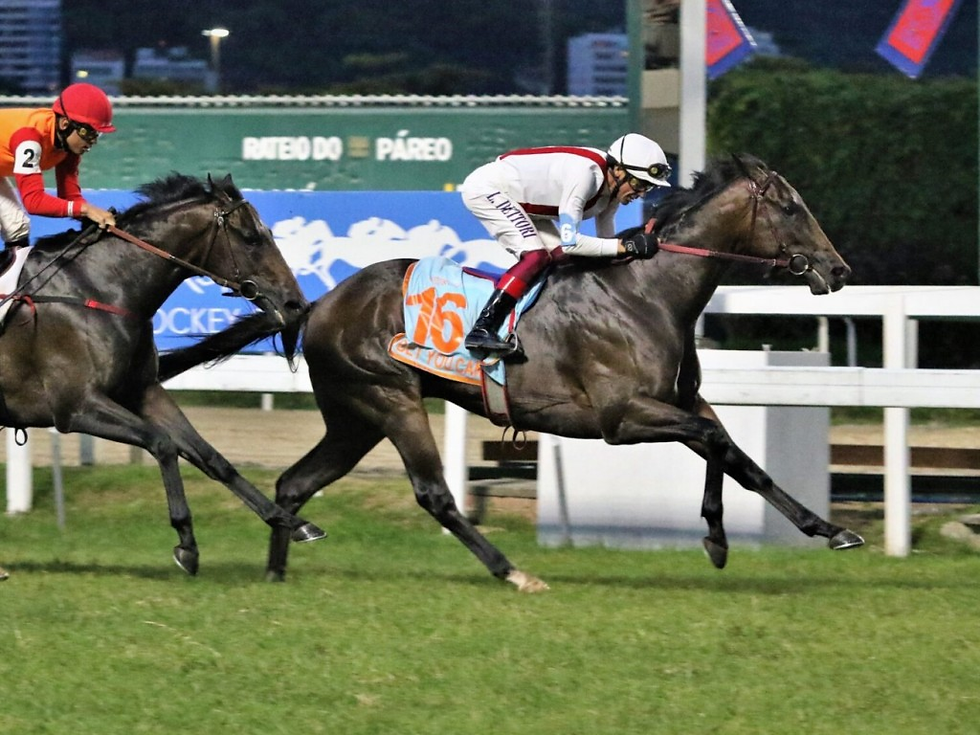
The Grande Prêmio Estado do Rio de Janeiro (G1) is a race reserved exclusively for three-year-old colts, contested over one mile on turf, and it represents one of the first major tests of the generation. Traditionally, it draws large fields, strong early tempos, and a competitive level that forces participants to perform at their peak early in the season. In this context, Bet You Can responded with authority, displaying a blend of tactical maturity and competitive ability that set him apart from the rest. With Dettori in the saddle, the colt positioned himself efficiently without expending unnecessary energy, advanced when the race dynamics allowed, and resolved decisively in the final stages, holding off his challengers and crossing the wire with a clear, if not overwhelming, advantage.
The significance of the victory is magnified by the fact that it was the final one of an unparalleled career. Frankie Dettori needs no introduction: winner of more than 500 Group races, multiple champion across Europe, the United States, and the Middle East, protagonist of legendary afternoons such as his historic “Magnificent Seven” at Ascot, and a central figure in global racing for more than three decades. His ability to read races, adapt to different horses, and deliver under pressure made him an icon beyond statistics and trophies. That his final victory came in Brazil, in his first and only professional appearance in the country, adds an unexpected and deeply symbolic dimension.
Dettori now steps away from professional riding to begin a new chapter as an international ambassador for AMO Racing, one of the most dynamic and ambitious operations in global racing today. His role going forward will be tied to the promotion of the sport, institutional representation, and advisory work, channeling his experience and charisma into a different but equally influential position. He closed his riding career, however, exactly as he lived it: winning, in a Group 1, aboard a young horse, in a demanding race, and before a crowd that fully grasped the magnitude of the moment.
The equine protagonist of this story, Bet You Can, was no secondary figure in the tribute, but rather a legitimate winner on pure merit. Bred and owned by Haras Estrela Nova, one of Brazil’s most progressive breeding operations, the colt represents a modern breeding model built on solid foundations and clear long-term vision. All horses from the operation are raised at Haras Fronteira in Bagé, Rio Grande do Sul, a region historically associated with the quality of the Brazilian Thoroughbred, where breeding is understood as a comprehensive process that goes far beyond pedigree alone.
The victory in the Grande Prêmio Estado do Rio de Janeiro marked Bet You Can’s first Group 1 success, achieved in a race of maximum difficulty for his age and stage of development. It was not a tailor-made scenario nor the product of favorable circumstances; it was a direct confrontation with the best of his generation, resolved with poise and efficiency. That triumph immediately places him among the most relevant colts of the year and validates the work of everyone involved, from breeding through to race management.
From a genetic standpoint, Bet You Can is a son of Can The Man, a stallion who has found fertile ground in Brazil to express his potential. Can The Man, a direct son of Into Mischief, was an elite racehorse and a Group 1 winner, and his relocation to Brazil generated significant expectations. His progeny has shown a fairly consistent pattern: he transmits speed, precocity, and competitiveness up to one mile, producing effective and reliable runners over intermediate distances. He is not, generally speaking, a natural source of extended stamina, but he does impart functional quality and responsiveness in demanding race scenarios.
Bet You Can’s dam, Bar Rouge, is a daughter of Pounced and had already demonstrated her value as a broodmare. Prior to Bet You Can, she produced Barzana, a daughter of Verrazano (More Than Ready), bred by Haras Legacy, also trained by Luiz Esteves, and a Group 3 winner in Brazil, clearly excelling in sprint and speed-oriented races. This detail is fundamental to understanding the colt’s true profile: his female line is not geared toward classic stamina, but rather toward efficiency over short to intermediate distances. Bet You Can, therefore, is not a genetic anomaly, but a coherent expression of his pedigree.
In that sense, his victory over the mile at Gávea becomes even more valuable. He performed at the upper limit of his optimal range, maximizing his resources without compromising his physical structure. This naturally raises an intriguing question regarding his immediate future. Racing logic suggests he will attempt the second leg of the Carioca Triple Crown over 2,000 meters. Strategically, it is a natural step after winning the 2,000 Guineas; genetically, it represents a significant challenge. Those additional 400 meters constitute a major leap, not only physically, but also in terms of energy distribution and mental resilience.
Should Bet You Can manage to adapt to that distance, his status would rise considerably. If, on the other hand, stamina proves to be a clear limitation, an alternative path is already well defined. Returning to the mile, where he has already proven competitive at the highest level, and targeting the Grande Prêmio Presidente da República during the Grande Prêmio Brasil meeting on June 14, 2026, at Gávea, emerges as a logical and sporting option. That race, one of the most prestigious mile events on the Brazilian calendar, could become the ideal stage for him to consolidate his position as one of the best specialists of his generation.
The impact of Can The Man during the classic meeting was not limited to Bet You Can. Earlier that same afternoon, the Brazilian 1,000 Guineas, the Grande Prêmio Henrique Possolo (G1), were contested, with victory going to Veil, a filly also by Can The Man, bred at Haras Santa Julieta by veterinarian Dr. Aline Vivian. Veil confirmed that the stallion is capable of producing Group 1 winners in both colts and fillies, reinforcing his standing within the Brazilian breeding landscape. Second in that race was Like It Hot, a filly bred by Haras Estrela Nova and sired by the national stallion Arrocha (Pounced), another proven name within the local breeding program.
This dual prominence, Bet You Can in the 2,000 Guineas and Veil in the 1,000 Guineas, places Can The Man (Into Mischief) at the very center of the Brazilian classic scene and confirms that his arrival in the country was not a mere experiment, but a breeding investment with tangible results. At the same time, it underscores the strong momentum of operations such as Estrela Nova and Santa Julieta, which are successfully translating planning, selection, and management into top-level outcomes.

Frankie Dettori’s final victory, therefore, was not an isolated episode, but rather the point of convergence of multiple narratives: the farewell of a legend, the consolidation of a breeding project, the validation of an imported stallion, and the emergence of a competitive generation within Brazilian racing. Bet You Can proved to be the perfect vehicle for that conclusion: a young colt with proven talent, a clear genetic profile, and an open future.
Time will ultimately determine how far he can go. If he adapts to 2,000 meters, he will enter a higher dimension altogether. If not, his quality over a mile ensures continued prominence in the sport’s biggest events. What can never be taken away is that he was the final Group 1 winner ridden by Frankie Dettori, a distinction that forever secures his place in the history of world racing.


Comments